When evaluating a refrigerator water filter manufacturer for OEM or wholesale supply, compare the exact product configuration, supporting documents and commercial scope together. This guide covers seven criteria for shortlisting suppliers. For the next stage, review our private label packaging options and build a model-specific order brief.
1. Tooling Precision and Model Compatibility
Small differences in locking features, seal grooves or connector geometry can affect installation and sealing. There is no single tolerance that proves compatibility across every refrigerator platform. Ask how the supplier identifies the proposed cartridge, checks critical dimensions and responds when an appliance connection changes.
- Tooling responsibility: Identify who controls the housing drawing and tooling, including outsourced operations. Dedicated tooling is a useful discussion point, but ownership alone does not establish product quality.
- Connection verification: Request evidence of insertion, locking and sealing for the intended application. A photo of a similar cartridge or a general brand list is insufficient.
- Seals and materials: Ask for the seal material, dimensional requirements and applicable supporting documents. Do not assume every model uses dual O-rings, the same elastomer or the same lubricant.
Start with compatible refrigerator water filter models, then use the compatibility guide to collect exact references and connector photos. For example, the GE MWF-compatible product is one defined reference; a GE grouping does not make every GE filter interchangeable. Keep the offered SKU, reference and sample identifier on the same record.
2. Filtration Media: Inside the Carbon Block
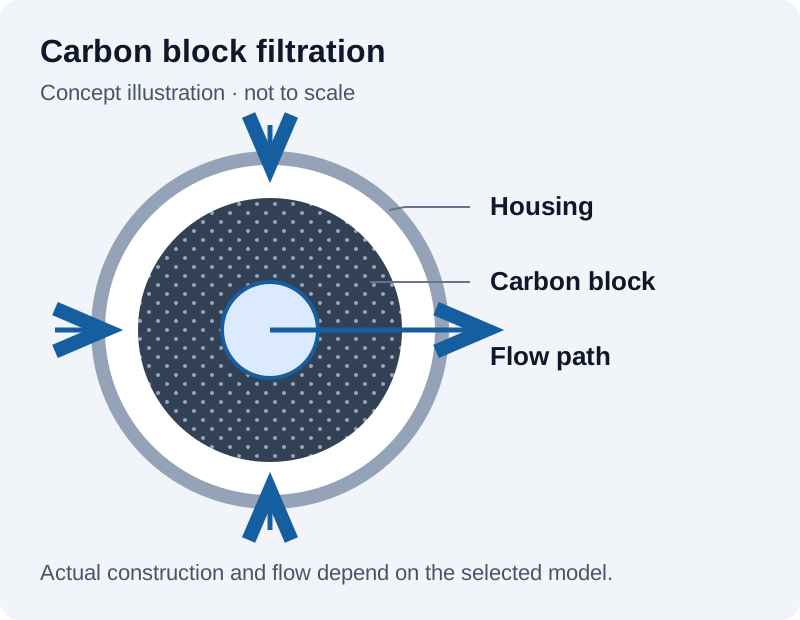
Two cartridges can share an external shape while using different media and internal flow paths. Ask whether the offered construction uses a carbon block or loose granular activated carbon, what raw material is specified and how media changes are controlled. Neither the housing shape nor the word “carbon” establishes a particular reduction claim.
Why the Media Specification Matters
Activated carbon provides an adsorption surface. Its formulation, pore structure, available surface, flow conditions and the substance being treated all matter. A carbon block holds the media in a formed structure, but the block, seals and housing must work together. Avoid unconditional claims such as “no channeling,” “no carbon fines” or universal superiority over another carbon source.
FridgeFilt supplies filters using Coconut Shell Activated Carbon Block media and a Food Grade Plastic Housing. Match that material description to the proposed cartridge and its component documents. If a particular block-forming process is required for your program, include it in the technical inquiry rather than inferring it from an external product photograph.
Parameters to Compare on the Same Basis
| Parameter | FridgeFilt Published Information | Buyer Verification |
|---|---|---|
| Filter material | Coconut Shell Activated Carbon Block | Match the component specification to the selected cartridge. |
| Housing | Food Grade Plastic Housing | Request relevant material and product documents. |
| Capacity | 300 Gallons | Confirm the applicable claim, model and rating conditions. |
| Service life | 6 Months | Consider usage and incoming water; do not promise identical results everywhere. |
| Flow rate | Model-specific confirmation required | Compare the inlet pressure, temperature and measured flow together. |
Published capacity and time are separate limits to discuss, not proof of identical independently tested performance for every SKU. The carbon block capacity and service-life guide explains how to read these specifications together.
3. Certification Transparency: Component vs. Whole-Filter Claims
Procurement teams should identify the certified object before approving packaging or marketplace copy. NSF's standards overview distinguishes aesthetic reduction under NSF/ANSI 42 from specified health-related contaminant reduction under NSF/ANSI 53. A reference to either standard does not establish every possible reduction claim.
NSF/ANSI/CAN 372 addresses lead content in covered products or components. It is not evidence of removing lead from incoming water. Check the current listing, holder, exact model, scope and any proposed mark use.
FridgeFilt's confirmed statement is: Carbon block component certified according to NSF/ANSI 42, 53 and 372 requirements. This is a component statement, not certification of the complete refrigerator filter cartridge. Request the applicable component document and any separate evidence needed for a proposed finished-filter claim before approving artwork.
4. Quality Control and Leakage Testing
A useful quality discussion names the inspection, method, acceptance criteria and retained record. FridgeFilt's confirmed factory quality control includes Incoming Material Inspection, Carbon Block Inspection, Leakage Testing, Flow Testing and Packaging Inspection. Ask what evidence is available for the selected model and order.
For leakage testing, confirm the test medium, pressure, hold time, fixture and acceptance decision. For flow testing, request the inlet conditions, configuration and result. A leakage check does not establish contaminant reduction, and a flow result does not prove pressure-cycle endurance.
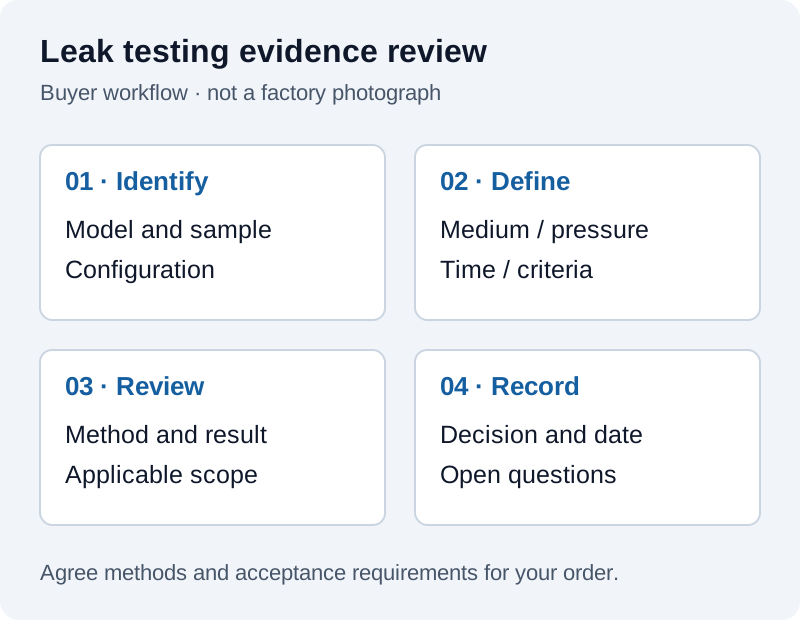
If your program requires burst, pressure-cycle or transport evaluation, specify the applicable method and request a quotation for that scope. Do not assume a factory uses ultrasonic welding, performs 100% pneumatic testing or meets a particular burst pressure because another supplier does. Use the manufacturer audit checklist when moving from a shortlist to detailed qualification.
5. Sample Validation Before a Bulk Order
Obtain samples that represent the proposed supplied configuration. Record the model, component version, packaging and any differences from the intended bulk item before comparing candidate suppliers.
- Inspect identity and condition: Check the label, connector, locking features, seals and damage. Weight or a shake test alone cannot prove media type or assembly quality.
- Check fit and sealing: Have a qualified reviewer evaluate the intended application under agreed conditions and retain the observations.
- Review flow and flushing: Use model-specific instructions and record the test conditions. Clear-looking water does not demonstrate contaminant reduction.
- Agree the accepted reference: Keep the sample identifier, photographs, reviewed documents and outstanding questions together.
If an internal cut-open examination is required, arrange it as a controlled destructive inspection by qualified staff. Do not install a cartridge that has been cut or otherwise modified. Internal appearance can inform construction review; it does not replace performance evidence.
6. MOQ, Lead Time and Supply Planning
FridgeFilt publishes a standard product MOQ of 180 pcs and private label / custom orders starting from 1,000 pcs. Confirm allocation by model, packaging version and order configuration. The starting quantity does not automatically establish a per-SKU rule, a mixed-model allowance or the price of every customization option.
For custom samples, the published dispatch timing is 14 days after artwork approval. Bulk production and delivery timing require project-specific confirmation. Separate artwork approval, sample dispatch, production release and arrival dates in your inventory plan; one milestone should not be substituted for another.
Ask how component or packaging changes will be communicated on repeat orders. For a seasonal purchasing program, discuss forecast quantities and replenishment timing without assuming local stock, reserved capacity or a guaranteed production window.
7. Compare the Complete Quotation
Give each shortlisted refrigerator water filter supplier the same model list, quantities, destination and packaging brief. Compare sample charges, print setup, packed-unit counts, transport scope and payment terms alongside cartridge price. Request a written list of exclusions rather than assuming an attractive unit price covers the entire launch.
For example, two offers for 1,000 cartridges may include different retail boxes or document scopes. Record the difference before negotiating price. Keep fit approval, claims approval and commercial acceptance as separate decisions so a purchasing signature does not accidentally close an unresolved technical question.
Frequently Asked Questions
How can I distinguish a manufacturer from a trading company?
Ask the supplier to identify the legal supply entity, manufacturing locations and outsourced operations. Review a relevant site walkthrough and traceable production or inspection records. A workshop video alone does not establish ownership, capability for every SKU or delivery reliability.
Can I mix models in one wholesale order?
Send quantities by model and packaging version for confirmation. Mixing arrangements and MOQ allocation depend on the order; do not assume carton-level mixing or per-model private label terms without a written quotation.
What documents should I request before an OEM order?
Request exact model references, material and product specifications, applicable component certification documents, agreed inspection evidence and the approved packaging revision. Identify the scope covered by each document rather than treating one certificate as evidence for the whole range.
Discuss Your OEM and Wholesale Requirements
FridgeFilt supports brands, importers and appliance parts distributors sourcing compatible replacement filters with custom logos, color boxes, manuals and packaging. Review the OEM and private label program and provide your references, quantities, market and document requirements to request a sample or wholesale quote.
Browse Compatible Filter Models → · Request Sample Testing & Wholesale RFQ →